

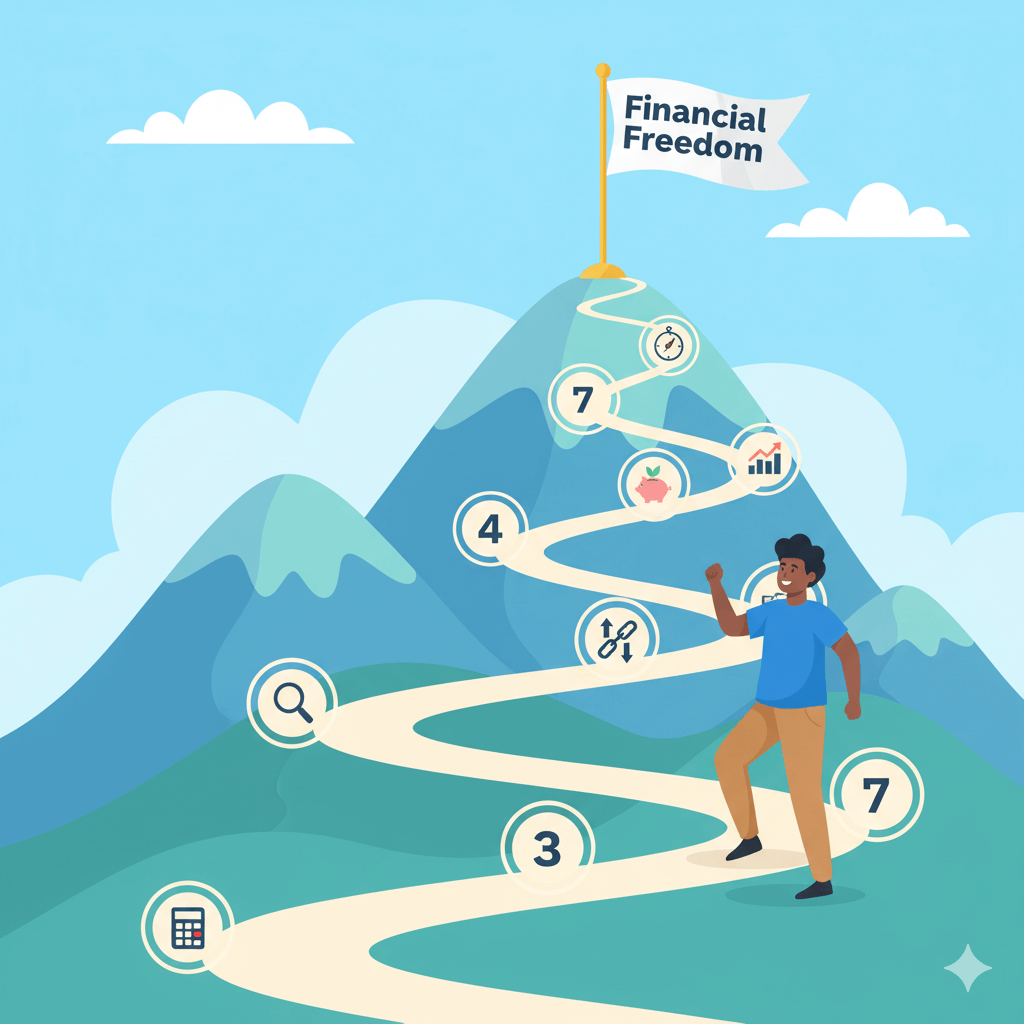
Financial Freedom: 7 Simple Steps to Retire Early
Did you know that only 16% of Americans feel confident they’ll have enough money to retire comfortably, yet those who follow a structured financial freedom plan retire an average of 15 years earlier than their peers? The path to financial freedom isn’t reserved for the wealthy elite or lottery winners—it’s a methodical journey that anyone with discipline and the right strategy can achieve.
Imagine waking up without an alarm clock, spending your days pursuing passions rather than paychecks, and having complete control over your time. That’s the promise of financial freedom, and it’s more attainable than you think. Whether you’re 25 or 55, drowning in debt or just starting your wealth-building journey, the seven steps outlined in this guide will provide a clear roadmap to early retirement.
The traditional retirement age of 65 is becoming obsolete. The FIRE movement (Financial Independence, Retire Early) has shown that with strategic planning, aggressive saving, and smart investing, you can achieve financial freedom decades earlier. In this comprehensive guide, we’ll break down exactly what you need to do, how long it takes, and the realistic income targets that will set you free from the 9-to-5 grind forever.
Love earning on your own terms? Unlock your potential with these high-income skills and get inspired to share your own success story!
How to Make Money Graphic Design: Your Path to Creative Financial Freedom in 2025
SEO for Beginners: Learn How to Get Free Traffic to Any Website
10 High-Income Skills You Can Learn Online for Free (No Degree Needed)
What You’ll Need to Get Started
Achieving financial freedom requires specific tools, mindsets, and resources:
Essential Financial Tools:
- Budgeting app or spreadsheet (Mint, YNAB, or free Google Sheets)
- High-yield savings account (earning 4-5% APY)
- Investment brokerage account (Vanguard, Fidelity, or Charles Schwab)
- Retirement accounts (401k, IRA, Roth IRA)
- Net worth tracking system
- Debt payoff calculator
Initial Investment Breakdown:
- $0 to start learning and planning
- Emergency fund: 3-6 months of expenses (build gradually)
- Investment account minimum: $0-$1,000 depending on brokerage
- Educational resources: $0-$500 (many free options available)
Skills Required:
- Basic budgeting and expense tracking (beginner-friendly)
- Understanding of compound interest (easily learned)
- Investment fundamentals (free courses available)
- Discipline and delayed gratification
- Goal-setting and progress monitoring
Beginner-Friendly Alternatives:
- Can’t afford a financial advisor? Use free robo-advisors like Betterment or Wealthfront
- No investment knowledge? Start with target-date retirement funds
- Limited income? Focus on increasing earnings before aggressive investing
- High debt? Debt snowball method provides psychological wins
Free Resources:
- Library books on personal finance (Rich Dad Poor Dad, The Simple Path to Wealth)
- YouTube channels: Graham Stephan, Andrei Jikh, Minority Mindset
- Podcasts: ChooseFI, BiggerPockets Money, Afford Anything
- Reddit communities: r/financialindependence, r/personalfinance
- Government resources: IRS retirement planning tools
The beauty of achieving financial freedom is that it requires minimal upfront investment—your most valuable asset is commitment to the process.

Time Investment
Building wealth for early retirement requires consistent effort and patience:
Initial Setup Phase:
- Creating comprehensive budget: 4-8 hours
- Opening investment accounts: 2-4 hours
- Establishing automated systems: 3-5 hours
- Financial education foundation: 20-40 hours
- Debt payoff plan creation: 2-3 hours
Daily/Weekly Commitment:
- Daily expense tracking: 5-10 minutes
- Weekly budget review: 30 minutes
- Monthly investment contributions: 1 hour (automate to reduce)
- Quarterly financial check-ins: 2-3 hours
- Annual goal reassessment: 4-6 hours
Timeline to Financial Freedom: Most people following aggressive saving strategies achieve financial freedom in 10-20 years, depending on starting point and savings rate:
| Savings Rate | Years to Financial Freedom |
|---|---|
| 10-15% | 40-50 years |
| 25% | 30-35 years |
| 50% | 15-17 years |
| 65% | 10-12 years |
| 75%+ | 7-10 years |
Realistic Milestones:
- First $10,000 saved: 6-18 months
- Debt-free status: 2-5 years (varies by debt load)
- $100,000 net worth: 3-7 years
- Coast FIRE (enough invested to retire at 65 without additional contributions): 5-10 years
- Full financial freedom: 10-25 years
Compared to Traditional Approach: The average American working until 65 invests 30-40 years with modest 10-15% savings rates. By increasing your savings rate to 50%+, you can achieve the same financial security in half the time, giving you decades of freedom to pursue meaningful work, travel, or passion projects on your terms.
Step-by-Step Implementation Guide
Step 1: Calculate Your Financial Freedom Number
Your financial freedom number is the amount of money you need invested to live off returns indefinitely. Use the 4% rule: multiply your annual expenses by 25.
Example: If you need $40,000 annually, your financial freedom number is $1,000,000 ($40,000 × 25).
Pro Tip: Calculate three scenarios—lean FIRE ($30,000/year), standard FIRE ($50,000/year), and fat FIRE ($75,000+/year)—to understand your options and motivation levels.
Common Question Addressed: “Isn’t $1 million unrealistic?” Not at all. With a 50% savings rate on a $60,000 salary, you’d reach $1 million in approximately 15-17 years through consistent investing in index funds averaging 8% returns.
Step 2: Audit Your Current Financial Situation
Track every expense for 30 days to understand where your money goes. Calculate your current net worth (assets minus liabilities). Determine your savings rate (percentage of income saved monthly).
Insider Trick: Most people discover they’re spending 20-30% on “invisible” expenses—subscriptions, eating out, and impulse purchases. This audit alone typically reveals $300-$800 monthly in reducible expenses.
Document everything: income sources, fixed expenses, variable expenses, debts, assets, and current investment balances. This snapshot becomes your baseline for measuring progress.
Step 3: Eliminate High-Interest Debt Aggressively
Prioritize paying off credit cards, personal loans, and any debt above 6% interest rate. Use either the debt avalanche method (highest interest first) or debt snowball method (smallest balance first for psychological wins).
Pro Tip: Every dollar spent on interest is a dollar stolen from your financial freedom. A $5,000 credit card balance at 18% APR costs $900 annually in interest—that’s $900 that could have grown to $3,400 over 15 years if invested instead.
Consider balance transfer cards with 0% APR introductory periods, negotiate lower rates with creditors, or use debt consolidation if it lowers your overall interest rate. Never take on new debt during this phase.
Step 4: Build Multiple Income Streams
Relying solely on one job creates fragility. Develop 2-4 income sources to accelerate wealth building and provide security.
Income Stream Options:
- Primary employment (optimize through raises, promotions, or job hopping)
- Side hustle ($500-$3,000+ monthly)
- Freelancing or consulting (leverage your expertise)
- Rental income (house hacking or investment properties)
- Digital products (courses, ebooks, templates)
- Dividend-paying investments (passive income)
Pro Tip: Your first $100,000 is the hardest to accumulate. Multiple income streams can cut your timeline in half. Someone earning $60,000 who adds $20,000 in side income can reach financial freedom 5-7 years faster.
Common Question: “I don’t have time for a side hustle.” You don’t need 20 extra hours weekly. Even 5-7 hours can generate $500-$1,000 monthly, adding $6,000-$12,000 annually to your financial freedom fund.
Step 5: Maximize Tax-Advantaged Investing
Leverage every available tax-advantaged account before using taxable accounts.
Priority Order:
- 401(k) up to employer match (free money)
- Max out HSA if eligible ($4,150 individual, $8,300 family in 2024)
- Max out Roth IRA ($7,000 in 2024, $8,000 if 50+)
- Complete 401(k) maximum ($23,000 in 2024, $30,500 if 50+)
- Backdoor Roth if income exceeds limits
- Taxable brokerage accounts for additional savings
Insider Trick: HSAs are triple tax-advantaged—contributions are tax-deductible, growth is tax-free, and withdrawals for medical expenses are tax-free. After age 65, they function like traditional IRAs. Many financial freedom seekers consider HSAs their secret weapon.
Invest in low-cost index funds (S&P 500, total stock market) with expense ratios under 0.10%. Avoid actively managed funds with high fees that erode returns over decades.
Step 6: Optimize Your Savings Rate Aggressively
Your savings rate is the single most important factor determining your financial freedom timeline. Aim for 50%+ of take-home income.
Savings Rate Strategies:
- Automate investments immediately after payday
- Live on last year’s income (bank all raises)
- Implement 30-day waiting periods for non-essential purchases
- Optimize big three expenses (housing, transportation, food)
- Eliminate lifestyle inflation permanently
Pro Tip: Most people say “I can’t save 50%,” but they’re calculating wrong. You don’t need to save 50% of gross income—save 50% of take-home pay. Someone earning $60,000 ($45,000 after taxes) needs to save $22,500 annually, living on $22,500.
Real Example: A couple earning combined $85,000 reduced housing from $2,000 to $1,200 (house hacking), transportation from $800 to $300 (sold one car), and food from $800 to $500 (meal planning), saving an additional $1,600 monthly or $19,200 annually—reaching their financial freedom goal 6 years faster.
Step 7: Monitor, Adjust, and Stay Consistent
Review your progress monthly and adjust annually. Track your net worth growth, calculate your savings rate, assess investment performance, and recalibrate your financial freedom number as needed.
Pro Tip: Celebrate milestones: first $25k, $50k, $100k, $250k, $500k, and $1M. These psychological wins maintain motivation during the long journey.
Join financial freedom communities (Reddit’s r/financialindependence, local FI meetups) for accountability and inspiration. Surround yourself with like-minded individuals who support your unconventional path.
Insider Trick: Use the “years to FIRE” calculator monthly. Watching your timeline shrink from 20 years to 15 to 10 provides powerful motivation. Conversely, if your timeline extends, it signals needed course corrections before small problems become major setbacks.
Income Potential & Earnings Breakdown
Financial freedom isn’t about earning potential—it’s about the wealth you build and the passive income it generates:
Target Net Worth by Age (Financial Freedom Track):
| Age | Aggressive Saver | Moderate Saver | Slow Builder |
|---|---|---|---|
| 30 | $100,000-$200,000 | $50,000-$100,000 | $20,000-$50,000 |
| 35 | $300,000-$500,000 | $150,000-$250,000 | $75,000-$150,000 |
| 40 | $700,000-$1,000,000 | $300,000-$500,000 | $175,000-$300,000 |
| 45 | $1,200,000-$1,800,000 | $500,000-$800,000 | $300,000-$500,000 |
Passive Income at Financial Freedom:
Based on the 4% safe withdrawal rate:
- $500,000 portfolio = $20,000 annual passive income
- $1,000,000 portfolio = $40,000 annual passive income
- $1,500,000 portfolio = $60,000 annual passive income
- $2,000,000 portfolio = $80,000 annual passive income
Real-World Case Studies:
Case Study 1: Software engineer couple (combined $150k income) achieved $1.2M in 12 years through 65% savings rate, house hacking, and side income. Now receive $48,000 annually in passive income while traveling the world.
Case Study 2: Teacher ($55k salary) reached $800k in 18 years by living extremely frugally (35% spending rate), maxing all retirement accounts, and investing aggressively in index funds. Now works part-time by choice, not necessity.
Case Study 3: Entrepreneur built $2.3M through combination of business sale ($800k), aggressive investing ($1.2M), and rental properties ($300k equity) over 15 years. Generates $92,000 annually without working.
Timeline Acceleration:
Every 10% increase in savings rate typically shaves 3-5 years off your financial freedom timeline. Someone earning $70,000 who increases savings from 30% to 50% reduces their timeline from 28 years to 17 years—an 11-year gain.
Alternative Methods & Variations
Traditional FIRE (Financial Independence, Retire Early): Save 25x annual expenses, retire completely. Best for: those who want complete work freedom. Typical timeline: 10-20 years. Pros: complete autonomy. Cons: requires aggressive saving, potential boredom.
Lean FIRE: Retire on minimal budget ($25,000-$35,000 annually). Best for: minimalists who prioritize freedom over luxury. Target portfolio: $625,000-$875,000. Achievable 5-10 years faster than standard FIRE but requires permanent frugality.
Barista FIRE: Save enough that investment returns plus part-time income cover expenses. Best for: people who enjoy some work structure. Target: 50-70% of full FIRE number. Provides healthcare benefits through part-time employer while maintaining flexibility.
Coast FIRE: Save aggressively early, then stop contributing while investments grow to full retirement age. Best for: those who want reduced work stress now. Example: $300k invested at age 35 grows to $1.3M by 65 without additional contributions.
Fat FIRE: Build substantial wealth for comfortable lifestyle ($75,000-$150,000+ annually). Target portfolio: $2-4M+. Timeline: 15-25 years. Pros: maintain high quality of life. Cons: requires high income or longer timeline.
Geographical Arbitrage (Geo-Arbitrage): Achieve financial freedom faster by relocating to lower cost-of-living areas or countries. $500,000 might be lean FIRE in San Francisco but fat FIRE in Portugal, Mexico, or Thailand. Reduces required savings by 40-60%.
Real Estate FIRE: Build portfolio of rental properties generating passive income covering expenses. Leverage allows faster accumulation but requires property management. Many achieve this with 5-15 rental units providing $3,000-$8,000 monthly cash flow.
Combining Approaches: Most successful early retirees use hybrid models—index funds plus rental income plus part-time passion work. Diversification reduces risk and provides flexibility.
Best Practices & Optimization Tips
Maximize Compound Interest: Start immediately. Money invested at 25 has twice the growth potential as money invested at 35. A $10,000 investment at age 25 grows to $147,000 by 65 (assuming 7% returns), while the same investment at 35 only reaches $76,000.
Efficiency Hacks:
- Automate everything: investments, bill payments, savings transfers
- Use credit card rewards strategically (2-5% cash back = $500-$1,500 annually)
- Optimize tax withholdings to avoid giving government interest-free loans
- Batch decision-making to avoid decision fatigue
- Set annual “money dates” to review full financial picture
Cost Reduction Strategies:
- Housing: house hack, downsize, or relocate (typically saves $500-$1,500 monthly)
- Transportation: drive used cars 10+ years, bike commute, or go car-free (saves $400-$800 monthly)
- Food: meal planning and cooking eliminates 75% of food costs (saves $300-$600 monthly)
- Insurance: shop annually, increase deductibles on emergency-funded categories (saves $100-$300 monthly)
Advanced Optimization Techniques:
- Tax-loss harvesting in taxable accounts to reduce tax burden
- Roth conversion ladder for early IRA access without penalties
- Strategic charitable giving using appreciated securities
- 72(t) SEPP distributions for penalty-free early retirement account access
- Mega backdoor Roth contributions if employer plan allows (additional $46,000 annually)
Community Recommendations: Successful FIRE achievers recommend focusing on the “big three”—housing, transportation, and food—before obsessing over cutting small expenses. Reducing housing from 30% to 20% of income, transportation from 15% to 7%, and food from 10% to 6% typically saves 22% of income without feeling deprived.
Tool Recommendations:
- Personal Capital (free net worth tracking and investment analysis)
- Vanguard Personal Advisor Services (0.30% fee, minimum $50k)
- NewRetirement (detailed retirement planning)
- Projectionlab (advanced FIRE calculators)
Common Mistakes to Avoid
Lifestyle Inflation (82% of High-Earners Fall Victim): Upgrading lifestyle with every raise destroys wealth-building velocity. Real example: Doctor earning $250k but saving same percentage as when earning $75k (still only $15k annually instead of potential $125k). Prevention: Live on last year’s income indefinitely, invest all raises.
Underestimating Healthcare Costs: Healthcare before Medicare eligibility at 65 costs $500-$1,500 monthly for early retirees. Many achieve FIRE number only to discover they can’t afford insurance. Statistics: 23% of early retirees return to work due to healthcare costs. Prevention: Add $10,000-$15,000 annually to FIRE number calculations.
Timing the Market: Investors who try to time the market underperform buy-and-hold investors by 3-4% annually. Missing just the 10 best market days over 20 years reduces returns by 50%. Real example: Someone who panicked and sold during 2020 COVID crash missed the subsequent 70% gain. Prevention: Stay invested through all market conditions.
Failing to Diversify: Putting all investments in individual stocks or single asset class creates catastrophic risk. Enron employees lost retirement savings when company failed. Lessons from successful practitioners: 80-90% of portfolio in diversified index funds (total stock market, international, bonds), maximum 10-20% in individual investments.
Neglecting Relationships and Health: Becoming so frugal that relationships suffer or health declines defeats the purpose of financial freedom. Prevention: Budget for relationship maintenance, experiences with loved ones, and health optimization. Financial freedom means nothing without people to share it with and health to enjoy it.
Early Withdrawal Penalties: Accessing retirement accounts before 59½ triggers 10% penalties plus ordinary income taxes (effective 30-45% loss). Many early retirees discover they need more accessible funds. Prevention: Build substantial taxable investment accounts alongside retirement accounts, or learn penalty-free access strategies (Roth conversion ladder, 72(t) distributions, Rule of 55).
Long-Term Sustainability & Growth
Maintaining Financial Discipline Post-FIRE: The journey to financial freedom builds muscles of frugality and discipline—don’t abandon these habits once achieved. Many early retirees discover they naturally maintain 40-50% savings rates even when working becomes optional, creating growing financial buffer.
Portfolio Management During Retirement: Shift gradually from accumulation (100% stocks) to preservation (60-80% stocks, 20-40% bonds) as you approach financial freedom. Use bucket strategy: 1-2 years expenses in cash, 3-7 years in bonds, remainder in stocks. Rebalance annually to maintain target allocation.
Reinvestment During Early Retirement: Many financially independent individuals continue growing wealth through side projects, consulting, or passion businesses—not from necessity but enjoyment. This additional income compounds, creating increasingly bulletproof financial foundation.
Diversification Evolution: As wealth grows, diversify beyond just index funds: real estate (10-25%), I-bonds for inflation protection, alternative investments if sophisticated investor. Never put more than 5-10% in any single company, sector, or risky asset.
Healthcare Strategy Updates: Before 65 and Medicare: ACA marketplace subsidies, healthcare sharing ministries, or part-time work with benefits. After 65: Medicare + Medigap supplements. Budget increases as you age—healthcare costs rise 5-7% annually, outpacing general inflation.
Inflation Protection: Build 20% buffer into financial freedom number for inflation. Consider TIPS (Treasury Inflation-Protected Securities), I-bonds, or real estate with rental income naturally rising with inflation. Review 4% withdrawal rate annually—if portfolio grows faster than withdrawals, you’re winning.
Sequence of Returns Risk: Major market downturns in first 5 years of retirement can derail plans. Protection strategies: maintain higher cash reserves, reduce spending during down years, consider working part-time during market crashes, or delay retirement until after market recovery.
Social Security Integration: Don’t ignore Social Security in calculations. Delaying until age 70 increases benefits 76% over age 62 claiming. Someone achieving FIRE at 45 can live off portfolio until 70, then add Social Security, dramatically reducing portfolio withdrawal rate and increasing sustainability.
Legacy and Giving: Many financially free individuals discover profound satisfaction in philanthropy. Consider donor-advised funds for tax-efficient giving, supporting causes aligned with values, or creating educational trusts for next generation.
Future-Proofing Strategies: Build multiple layers of resilience: diversified income sources during working years, diversified investment vehicles, skills that remain marketable if return to work needed, strong social networks, excellent health habits. Financial freedom succeeds best when supported by life freedom—strong relationships, purposeful activities, and robust health.

Conclusion
Achieving financial freedom through early retirement isn’t magic—it’s mathematics. By calculating your specific number, aggressively optimizing your savings rate, diversifying income streams, maximizing tax-advantaged investing, and maintaining consistent discipline over 10-20 years, you can break free from mandatory employment decades before traditional retirement. The seven steps outlined provide your roadmap, but your commitment determines your timeline. Remember: every $1,000 invested today becomes $2,000 in 10 years, $4,000 in 20 years, and $8,000 in 30 years. The best time to start was yesterday. The second best time is right now.
Ready to start your financial freedom journey? Download our free FIRE Calculator Spreadsheet and join 50,000+ aspiring early retirees in our community. Drop your biggest financial freedom question in the comments below, and share this guide with anyone who dreams of escaping the 9-to-5 grind!
FAQs
How much money can I realistically accumulate for early retirement?
Your potential depends on three factors: income level, savings rate, and timeline. Someone earning $60,000 with 50% savings rate can accumulate $800,000-$1,200,000 in 15-17 years assuming 7-8% average investment returns. Higher earners or those with longer timelines can reach $2-3M+. The key is consistent high savings rates over time, not exceptional income.
Do I need prior financial experience to achieve FIRE?
No. Most successful early retirees started with zero financial knowledge. Basic concepts—spend less than you earn, invest the difference in index funds, let compound interest work—are simple to learn. Recommended starting point: read “The Simple Path to Wealth” by JL Collins and join r/financialindependence community. Within 3-6 months of self-education, you’ll know more than 90% of population about personal finance.
What’s the minimum initial investment required to start?
$0. You can open Vanguard, Fidelity, or Charles Schwab accounts with no minimum. Start with whatever you can afford—even $50 monthly grows to $34,000 in 20 years at 8% returns. Focus first on building emergency fund ($1,000 starter, then 3-6 months expenses) before aggressive investing. Many successful FIRE achievers started with negative net worth due to student loans.
How long until I see meaningful results from this strategy?
First milestone—$10,000 saved—typically takes 6-18 months depending on savings rate. Most people notice psychological shift within 3-6 months as spending habits change and net worth grows. However, truly feeling “progress” usually happens around $100,000 (3-7 years for most)—when compound interest starts generating noticeable returns. Full financial freedom: 10-25 years for most people, 7-10 years for extreme savers.
Is financial independence still achievable in 2025 and beyond?
Absolutely. While inflation and market volatility create challenges, the fundamental mathematics remain unchanged. Historical stock market returns average 10% nominal (7% after inflation). Tax-advantaged accounts offer same benefits. Real challenges: higher housing costs in some markets (solution: relocate or house hack), healthcare costs (factor into planning), and inflation (build buffer). However, technology enables more side income opportunities than ever, potentially accelerating timelines.
What are the biggest risks of pursuing early retirement?
Primary risks include: sequence of returns (market crash early in retirement depleting portfolio), healthcare costs exceeding projections, inflation eroding purchasing power, underestimating lifespan (money needs lasting 50+ years), boredom or loss of purpose without work structure, relationship strain if partner isn’t aligned, and inability to re-enter workforce if needed. Mitigation: maintain higher savings than minimum (30-40% buffer), develop multiple income streams, keep skills marketable, have strong non-work identity and relationships.
Can I achieve FIRE with average income or do I need six figures?
FIRE is absolutely achievable on average income with high savings rates. Teacher earning $55k achieving FIRE in 18 years proves this. Key isn’t income level—it’s gap between earning and spending. Someone earning $60k spending $30k (50% savings) reaches FIRE faster than someone earning $120k spending $90k (25% savings). However, higher income does accelerate timelines when combined with controlled spending.
Should I pay off mortgage early or invest for FIRE?
Depends on mortgage interest rate versus expected investment returns. If mortgage rate is below 4%, mathematically better to invest rather than pay down mortgage—your investments should return 7-10% over time, netting 3-6% gain. However, psychological peace of owning home outright has value. Many FIRE achievers compromise: invest aggressively while making normal mortgage payments, then pay off mortgage in final 2-3 years before FIRE date for reduced required portfolio size and psychological benefit of debt-freedom.
Your Feedback Informs Our Service
This article finally made financial freedom feel achievable! I’ve always been intimidated by the idea, but the step-by-step breakdown is so clear. Calculating my “Financial Freedom Number” was a lightbulb moment, and the pro tip about the three different scenarios (lean, standard, fat FIRE) completely changed my perspective. This is the roadmap I’ve been searching for.
Finally, a guide that provides concrete numbers and a real strategy instead of vague advice. The examples, like how a $5,000 credit card balance robs your future, hit home. The section on maximizing tax-advantaged accounts, especially the HSA “secret weapon,” is incredibly valuable. This is a data-driven, no-nonsense plan that I can immediately implement.
The multiple income streams section was a game-changer for me. I always thought I was too busy, but the idea that even 5-7 hours a week can make a massive difference is motivating. The real-life example of the couple saving $19,200 annually by optimizing their big three expenses was the push I needed to seriously audit my own spending. This article is both inspiring and intensely practical.