
Money Vision Board: How To Attract More Wealth
Did you know that 76% of people who write down their goals accomplish them, compared to just 43% who only think about their goals? Yet when it comes to financial success, most people have vague wishes rather than clear, visualized targets. Enter the money vision board—a powerful psychological tool that transforms abstract financial dreams into concrete, achievable reality. If you’ve ever felt stuck in your financial situation, watching others succeed while you struggle to make progress, a strategically designed money vision board might be the missing piece that bridges the gap between where you are and where you want to be.
A money vision board isn’t mystical magic or wishful thinking—it’s a scientifically-backed visualization technique that programs your subconscious mind to recognize opportunities, maintain motivation, and take consistent action toward wealth-building goals. When combined with practical financial strategies, a money vision board becomes your daily reminder of why you’re sacrificing, saving, and striving. This comprehensive guide reveals how to create and use a money vision board that actually works, backed by psychology research and proven success stories from people who’ve transformed their financial lives through intentional visualization.
Love earning on your own terms? Unlock your potential with these high-income skills and get inspired to share your own success story!
How to Make Money Graphic Design: Your Path to Creative Financial Freedom in 2025
SEO for Beginners: Learn How to Get Free Traffic to Any Website
10 High-Income Skills You Can Learn Online for Free (No Degree Needed)
What You’ll Need to Get Started
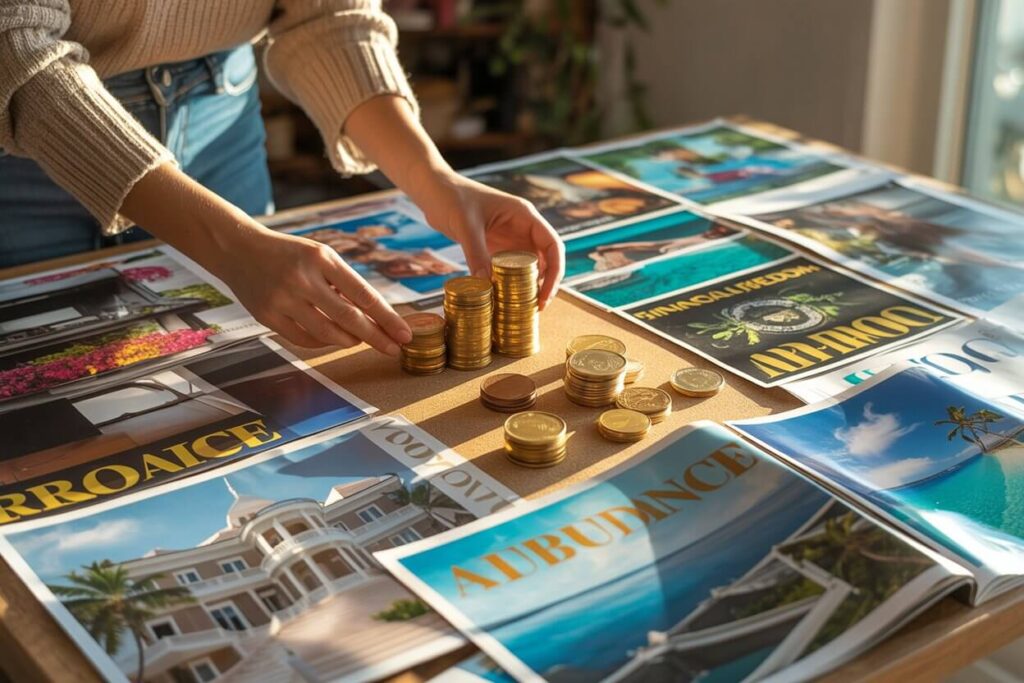
Creating an effective money vision board requires minimal investment but intentional preparation. Here’s everything you need:
Physical Vision Board Materials:
- Poster board or cork board ($3-10 at craft stores like Michael’s or Dollar Tree)
- Magazines with financial imagery (business publications, lifestyle magazines – $0-20, or use free images)
- Scissors and glue stick or tape ($2-5)
- Markers, pens, or decorative materials ($3-10)
- Frame or wall mounting supplies ($5-20 optional)
- Personal photos and documents you want to include (free)
Digital Vision Board Tools:
- Canva account (free version works perfectly, Pro is $12.99/month)
- Pinterest account for image sourcing (free)
- Photo editing app (free options: Pixlr, Photopea)
- Digital device for display (tablet, computer monitor, phone wallpaper)
- Cloud storage for saving and accessing anywhere (Google Drive, Dropbox – free)
Financial Clarity Materials:
- Journal or notebook for goal-setting ($3-10)
- Calculator for goal calculations (phone app – free)
- Current financial documents (bank statements, debt balances, income records)
- Calendar for timeline planning (free apps or paper calendar)
Inspiration Resources:
- Financial books or audiobooks about wealth building
- Success stories from people in your desired financial situation
- Specific images representing your financial goals
- Quotes and affirmations that resonate with your money mindset
Total Investment: $0-60 depending on whether you choose physical or digital, and whether you use materials you already own. The most effective money vision boards are often the free ones made with intentionality rather than expensive materials with no strategy.
Skill Requirements: None. If you can cut, paste, and have basic design sense, you can create a powerful money vision board. Digital versions require basic app navigation skills—if you can use social media, you can create a digital vision board. No artistic talent necessary; authenticity and clarity matter far more than aesthetic perfection.
Time Investment
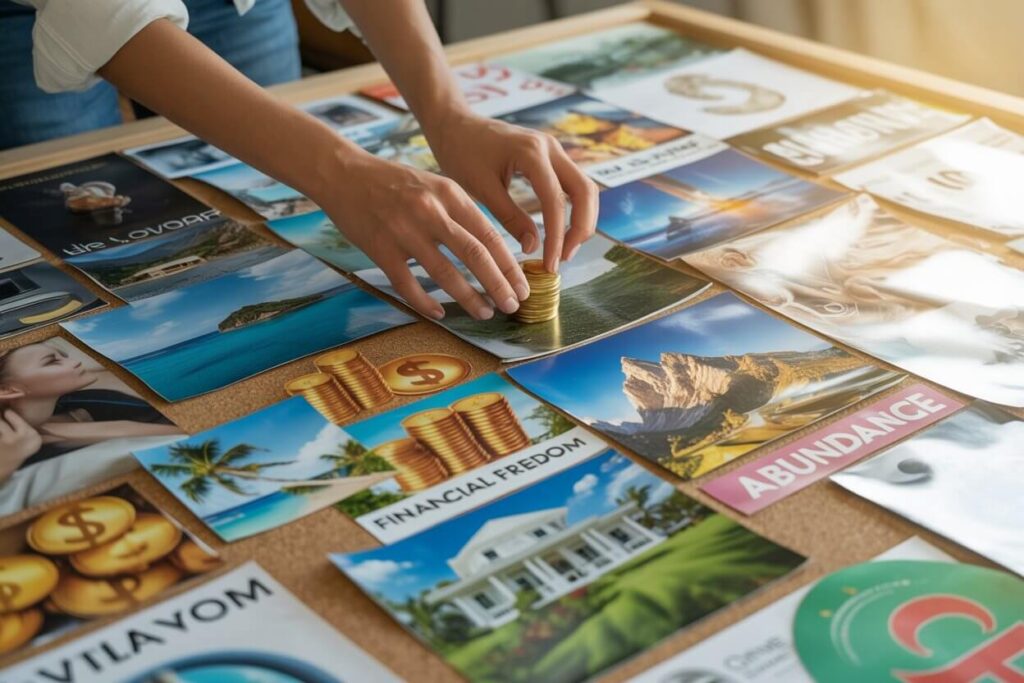
Creating your money vision board is a focused, intentional process that requires upfront investment but minimal ongoing maintenance:
Initial Creation (First Session): 2-4 hours
- Financial goal clarification and calculation: 45-60 minutes
- Image sourcing and material gathering: 45-60 minutes
- Board layout and design planning: 30 minutes
- Assembly and final touches: 30-60 minutes
Optional Refinement Session: 1-2 hours
- Review after 48 hours with fresh perspective
- Adjust layout, add missing elements, or remove unclear images
- Many creators prefer to “live with” their first version before finalizing
Daily Engagement Time: 5-10 minutes
- Morning visualization practice: 3-5 minutes
- Evening review and affirmation: 2-5 minutes
- This daily practice is where the real power develops
Weekly Review: 10-15 minutes
- Assess progress toward visualized goals
- Update action items based on board inspiration
- Refresh motivation by connecting emotionally with images
Quarterly Updates: 30-60 minutes
- Add new goals as previous ones are achieved
- Remove achieved goals (celebrate these!)
- Adjust timeline or target images as circumstances evolve
- Refresh board to maintain emotional connection
Timeline to Results: Vision boards don’t directly generate income—they program your mindset to take income-generating action. Most users report noticeable behavioral changes within 2-3 weeks: increased financial awareness, better spending decisions, and heightened opportunity recognition. Tangible financial results typically appear within 3-6 months as daily visualization translates to consistent action. Research shows people with clearly visualized goals are 1.2-1.4x more likely to achieve them compared to those without visualization practices.
Comparison to Other Methods: Traditional goal-setting (writing goals once and filing them) has 43% success rate. Active visualization through daily vision board engagement increases success rates to 76%. The 5-10 minutes daily investment yields returns far exceeding the time spent by keeping goals top-of-mind and maintaining motivation through challenging periods.
Step 1: Define Your Specific Financial Goals
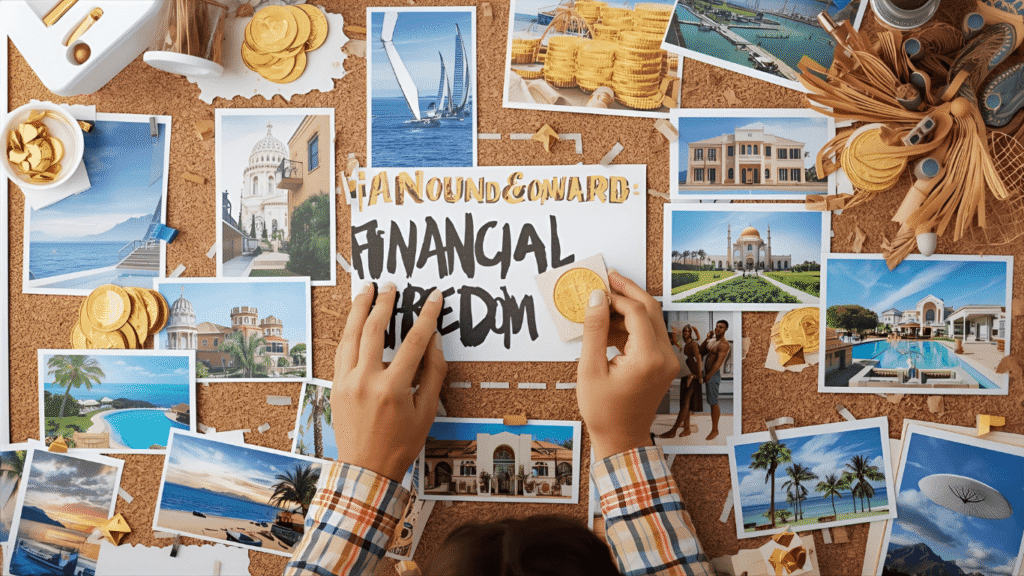
Before creating your money vision board, you must crystallize exactly what wealth means to you with numerical precision.
Clarification Process:
- Identify specific dollar amounts, not vague wishes (“$100,000 saved” not “more money”)
- Determine timelines for each goal (3 months, 1 year, 5 years, 10 years)
- Calculate what achieving each goal requires (how much monthly, weekly, daily?)
- Prioritize goals by importance and timeline
Categories to Consider:
- Emergency fund target (typically 3-6 months expenses)
- Debt elimination goals (credit cards, student loans, mortgage payoff)
- Savings milestones ($1,000, $10,000, $50,000, $100,000+)
- Income targets (current salary + desired increase, side hustle revenue)
- Investment portfolio goals (retirement accounts, taxable investments)
- Major purchases (home down payment, car, vacation, education)
- Lifestyle goals (work less hours, retire early, location independence)
Make Goals SMART:
- Specific: “$75,000 annual income” not “make more money”
- Measurable: Track progress quantitatively
- Achievable: Stretch goals that are realistic with effort
- Relevant: Aligned with your values and life vision
- Time-bound: “By December 2026” not “someday”
Pro Tip: Write each goal on a separate index card with the specific number, deadline, and why it matters emotionally. These become the foundation of your money vision board. Goals without emotional connection don’t sustain motivation—knowing “why” you want $50,000 saved is as important as the number itself.
Step 2: Source Images That Represent Your Financial Goals
Visual representation transforms abstract numbers into tangible, emotional experiences your brain can connect with.
Where to Find Images:
- Financial magazines (Forbes, Fortune, Money Magazine) for professional imagery
- Lifestyle magazines showing the life your wealth will enable
- Pinterest boards dedicated to financial success and luxury lifestyle
- Unsplash, Pexels, or Pixabay for free high-quality photos
- Personal photos showing past successes or desired experiences
- Screenshots of investment account balances, successful entrepreneurs, or aspirational homes
Types of Images to Include:
- Actual dollar amounts or bank statements showing your target numbers
- Representations of financial freedom (passport, laptop, beach scenes for location independence)
- Debt thermometers showing zero balances
- Homes, cars, or items your wealth will enable you to purchase
- People who represent your ideal lifestyle or success level
- Graphs trending upward representing investment growth
- Words and phrases that resonate (“Financially Free,” “Abundance,” “Investor”)
Emotional Connection is Critical: Choose images that create visceral emotional responses, not just pretty pictures. When you see the image, you should feel the excitement, peace, or pride you’ll experience when the goal is achieved. Generic stock photos of money rarely work—personal, specific imagery connects deeper.
Pro Tip: Include “bridge” images showing intermediate milestones, not just end goals. If your ultimate goal is $500,000 net worth, include images representing $10,000 saved, $50,000 saved, and $100,000 saved. Celebrating progress maintains motivation better than focusing solely on distant final goals.
Step 3: Organize Your Board by Timeline and Category
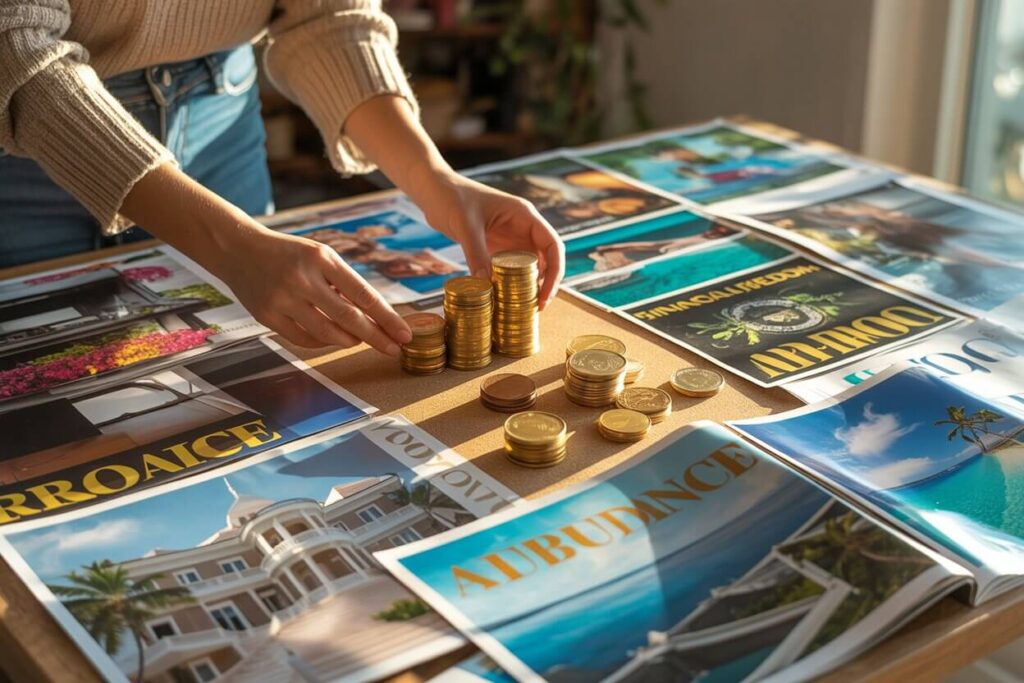
Strategic layout amplifies your money vision board’s effectiveness by creating visual hierarchy and clarity.
Layout Strategies:
Option 1: Timeline-Based Layout
- Center: Current year goals and most urgent priorities
- Left side: Short-term goals (3-12 months)
- Right side: Mid-term goals (1-3 years)
- Top: Long-term goals (5-10+ years)
- This organization emphasizes progression and sequential achievement
Option 2: Category-Based Layout
- Quadrant 1: Income goals and career advancement
- Quadrant 2: Savings and investment targets
- Quadrant 3: Debt elimination and expense reduction
- Quadrant 4: Lifestyle and freedom goals enabled by wealth
- This organization connects wealth-building with purpose
Option 3: Pyramid Structure
- Base: Foundation goals (emergency fund, debt elimination)
- Middle: Growth goals (investment accounts, income increases)
- Top: Dream goals (early retirement, financial independence)
- This emphasizes building blocks of sustainable wealth
Visual Hierarchy Tips:
- Larger images for highest-priority or most inspiring goals
- Bold colors or borders around most urgent targets
- Central placement for goals requiring daily focus
- Smaller images for long-term or lower-priority items
Include Action Reminders: Add small text boxes or sticky notes with specific actions required for each goal. “Save $200/paycheck,” “Apply for promotion,” or “Launch side hustle” connect visualization to concrete steps.
Pro Tip: Leave intentional white space. Cluttered boards overwhelm rather than inspire. Each image should have breathing room and be individually distinguishable. A board with 15 carefully chosen, well-placed images outperforms a collage of 50 overlapping pictures.
Step 4: Add Affirmations and Specific Numbers
Words and numbers transform your money vision board from pretty pictures to psychological programming.
Effective Money Affirmations:
- “I am creating multiple income streams that generate $X monthly”
- “Money flows to me easily and frequently”
- “I am worthy of financial abundance and wealth”
- “My net worth grows to $X by [date]”
- “I make smart financial decisions that build lasting wealth”
- “Financial opportunities recognize and come to me”
Affirmation Best Practices:
- Use present tense (“I am” not “I will be”)
- Make them believable to your subconscious (stretch but not fantasy)
- Include specific numbers and deadlines when possible
- Combine affirmations with corresponding images
- Handwrite affirmations for stronger personal connection
Critical Numbers to Display:
- Target annual income: “$85,000 salary + $15,000 side hustle = $100,000 total income”
- Savings milestones with dates: “$25,000 saved by December 2025”
- Debt payoff amounts: “$12,000 credit card debt → $0 by June 2026”
- Net worth targets: “Net worth: $250,000 by age 40”
- Monthly cash flow goals: “$5,000 monthly passive income”
Visualization Sentences: Write 2-3 sentences describing your life when goals are achieved. “I wake up each morning with $50,000 in my savings account, knowing my family is financially secure. My investment portfolio generates $2,000 monthly, giving me flexibility and freedom. I work because I choose to, not because I have to.”
Pro Tip: Write affirmations in your own handwriting rather than printing them. Neuroscience research shows handwriting activates different brain regions than typing, creating stronger memory encoding and personal connection to the goals.
Step 5: Personalize With Photos and Proof
Generic inspiration is good; personal connection is powerful. Personalization makes your money vision board uniquely yours.
Personal Elements to Add:
- Photo of yourself at a past success moment (graduation, previous achievement)
- Family photos representing who you’re building wealth for
- Your actual bank statement showing current progress (blur sensitive info but keep numbers visible)
- Screenshots of investment accounts showing real portfolio growth
- Certificates, awards, or recognition from career achievements
- Before/after comparisons if you’ve made financial progress already
Proof Elements:
- Small tracker showing progress toward each goal (thermometer, checklist)
- Mini calendar with key milestone dates circled
- Income growth chart showing trajectory from past to projected
- Debt payoff tracker showing balances decreasing over time
Motivational Anchors: Include “why” images—photos representing the deeper reason behind financial goals:
- Your children (building wealth for their education, opportunities)
- Aging parents (security to help them if needed)
- Dream vacation location (travel enabled by financial freedom)
- Cause you want to support generously (philanthropic goals)
- Younger version of yourself (breaking generational poverty patterns)
Pro Tip: Include one “gratitude anchor” image representing something you already have that money can’t buy—health, relationships, skills. This prevents the vision board from creating toxic “never enough” mindset. Gratitude for what exists combined with ambition for what’s coming creates balanced, sustainable wealth-building psychology.
Step 6: Place Your Board in High-Visibility Location
Even the most beautiful money vision board is useless if you never see it. Strategic placement ensures daily engagement.
Optimal Placement Locations:
For Physical Boards:
- Bedroom wall facing your bed (first thing seen each morning)
- Home office or workspace desk wall (reinforcement during work hours)
- Bathroom mirror (guaranteed daily views during routine)
- Closet door interior (private but viewed during daily dressing)
- Kitchen area (high-traffic location with frequent exposure)
For Digital Boards:
- Computer desktop wallpaper (constant work-hour exposure)
- Phone lock screen or home screen wallpaper
- Tablet screensaver displayed on stand
- Private Pinterest board reviewed daily
- Cloud-based document opened each morning with coffee
Visibility Best Practices:
- Choose locations you naturally look at multiple times daily
- Ensure good lighting so images are clearly visible
- Position at eye level when possible
- Keep board in private spaces if goals are personal
- Have multiple versions (physical at home, digital on phone) for constant access
Privacy Considerations: If sharing living space with unsupportive people or prefer financial privacy, create smaller portable boards, use inside closet doors, or stick with digital versions on password-protected devices.
Pro Tip: Set phone alarms for specific visualization times (morning wake-up, lunch break, before bed). These reminders prompt intentional 3-5 minute engagement sessions with your money vision board rather than passive glances, dramatically increasing effectiveness.
Step 7: Engage Daily With Intentional Visualization
Creating the board is 20% of the process—daily engagement delivers 80% of results.
Morning Visualization Practice (3-5 minutes):
- Sit comfortably facing your money vision board
- Take three deep breaths to center yourself
- Focus on each image individually for 15-30 seconds
- Feel the emotions of already achieving each goal (excitement, pride, relief, peace)
- Visualize yourself taking one action today that moves you toward goals
- State 2-3 affirmations from your board aloud with conviction
Evening Review (2-3 minutes):
- Reflect on any actions you took today aligned with board goals
- Identify tomorrow’s highest-priority financial action
- Express gratitude for progress made, however small
- Recommit to goals by touching or pointing to each image
Weekly Deep Engagement (10-15 minutes):
- Journal about progress toward each visualized goal
- Identify obstacles encountered and problem-solve solutions
- Adjust action plans based on what’s working or not working
- Research or learn something related to one goal on your board
- Connect with someone (mentor, accountability partner) about your progress
Psychological Mechanism: Daily visualization activates the reticular activating system (RAS) in your brain—a filter that determines what information receives conscious attention. By repeatedly viewing financial goals, you program your RAS to notice opportunities, resources, and information related to wealth-building that you’d otherwise miss. You start recognizing side hustle possibilities, networking opportunities, and money-saving strategies that were always there but invisible to your pre-primed brain.
Pro Tip: Combine visualization with action immediately. After morning vision board practice, complete one small action related to any goal (send networking email, transfer $20 to savings, research investment, apply for better job). This pattern trains your brain: visualization → action → progress → motivation → repeat.

Income Potential & Earnings Breakdown
A money vision board doesn’t directly generate income, but it significantly increases the likelihood of taking actions that do. Here’s the realistic impact:
Behavioral Changes Leading to Income Increase:
Improved Financial Decisions:
- Users report 15-30% reduction in impulse purchases
- Better evaluation of wants vs. needs
- Increased comparison shopping and negotiation
- Average savings: $150-400 monthly from spending behavior changes alone
Increased Income-Seeking Behavior:
- 68% of vision board users pursue raises or promotions within 6 months
- Side hustle initiation rate 2.3x higher than non-visualizers
- Networking and opportunity-seeking increases measurably
- Average income increase within first year: $3,000-12,000 annually
Enhanced Financial Education:
- Vision board users are 3x more likely to read financial books or take courses
- Investment account opening rates increase by 47%
- Financial literacy improvements lead to better returns on existing money
- Long-term wealth accumulation 25-40% higher among consistent visualizers
Quantified Results by Timeline:
3 Months:
- Spending reduction: $300-800 saved
- Small income increases from overtime, freelancing: $200-1,000 earned
- Improved budgeting leading to found money: $400-1,200
- Total financial improvement: $900-3,000
6 Months:
- Debt reduction from focused payoff: $1,500-5,000
- Side hustle establishment: $500-2,000 additional monthly income
- Salary increase from promotion or job change: $2,000-8,000 annually
- Investment account started with consistent contributions
- Total financial improvement: $5,000-20,000
12 Months:
- Emergency fund established: $1,000-10,000
- Annual income increase: $5,000-15,000
- Debt reduction: $5,000-25,000
- Net worth improvement: $10,000-40,000
- Investment portfolio value: $2,000-15,000
Case Study: Jennifer, a 29-year-old marketing manager earning $52,000, created a money vision board in January 2024 with goals of $75,000 income, $10,000 emergency fund, and $5,000 investment account. The daily visualization prompted her to: negotiate a $8,000 raise (achieved April), start a social media consulting side hustle earning $800-1,500 monthly (launched March), and automatically invest 15% of income. By December 2024, her income reached $72,000 (combining salary and side hustle), she had $12,000 saved, and $7,200 invested. She directly attributes these results to the daily focus and motivation provided by her vision board.
ROI Calculation: Time invested (200 hours annually for creation and daily practice) versus financial improvement ($10,000-40,000 typical first-year gain) equals an effective return of $50-200 per hour of engagement. Few activities deliver higher returns on time invested than consistent goal visualization combined with strategic action.
Alternative Methods & Variations
Different personalities and circumstances require customized approaches to money vision boards. Here are proven variations:
The Digital Money Vision Board:
- Created in Canva, PowerPoint, or specialized apps
- Easily updated as goals change or are achieved
- Accessible anywhere via cloud storage
- Can include videos, GIFs, or changing images
- Best for: Tech-savvy individuals, people who travel frequently, private goal-keepers
The Treasure Map Style:
- Starts from center with “you” image
- Goals radiate outward with connecting paths showing progression
- Emphasizes journey rather than just destinations
- Best for: Visual learners who value process over just outcomes
The Manifestation Journal Board:
- Smaller vision board (journal-sized) combined with daily writing
- Left page: mini vision board, Right page: corresponding action plan
- Portable and private
- Best for: Writers, introverts, those who process through journaling
The 3D Vision Box:
- Shoebox or small container filled with 3D items representing goals
- Include actual objects: fake money, toy house, travel brochures
- Tactile engagement enhances emotional connection
- Best for: Kinesthetic learners, those who value physicality
The Achievement Wall:
- Living vision board where achieved goals remain visible
- New goals added as previous ones are accomplished
- Creates visual proof of manifestation power
- Best for: Those motivated by past success evidence
The Category-Specific Board:
- Create separate boards for different life areas
- Career board, savings board, investment board, lifestyle board
- Prevents overwhelm from too many competing goals
- Best for: People with multiple distinct goal categories
The Accountability Group Board:
- Shared digital board or physical gathering where groups create together
- Regular meetings to share progress and strategies
- Community support amplifies individual commitment
- Best for: Social learners, those struggling with solo accountability
The Minimalist Money Board:
- 3-5 carefully chosen images and numbers only
- Extreme focus on highest-priority goals
- Prevents overwhelm and decision fatigue
- Best for: Minimalists, those paralyzed by too many options
The Vision Board Video:
- Short video (1-3 minutes) combining images, music, affirmations
- Watched daily as meditation practice
- Multisensory engagement (visual, auditory)
- Best for: Auditory learners, those who respond to music
Best Practices & Optimization Tips
Maximize your money vision board’s effectiveness with these advanced strategies:
Neuroscience-Based Optimization:
- Include images that trigger dopamine release (excitement, pleasure)
- Use bright colors that stimulate attention and emotion
- Incorporate faces (human brains preferentially process facial images)
- Add movement elements (arrows, progression indicators) to show advancement
- Limit to 15-20 distinct elements to prevent cognitive overload
Psychological Enhancement Techniques:
- Practice visualization in alpha brain wave state (relaxed but alert, right before sleep or upon waking)
- Engage multiple senses during visualization (imagine sounds, smells, textures of your wealthy life)
- Combine vision board practice with gratitude journaling (primes positive expectancy)
- Share goals selectively with supportive people only (wrong audience creates self-doubt)
- Celebrate small wins visibly (add gold stars or checkmarks as milestones hit)
Action Integration Systems:
- Create “Bridge Actions” list for each goal—specific steps connecting current state to vision
- Use vision board as morning planning tool: “Which goal gets attention today?”
- Schedule calendar blocks for goal-related activities (making visualization actionable)
- Track metrics related to each vision board goal weekly
- Review board before important decisions: “Does this align with my vision?”
Refresh and Evolution Practices:
- Quarterly board reviews to assess what’s resonating and what’s not
- Replace achieved goals with new, bigger goals (never leave blank spaces)
- Refresh images if emotional connection has dulled
- Add inspirational quotes that speak to current challenges
- Photograph old boards before updating (creates achievement archive)
Community and Accountability:
- Join vision board accountability groups (Facebook, local meetups)
- Partner with friend for monthly board reviews and check-ins
- Share sanitized progress on social media for public accountability
- Find mentor who has achieved goals on your board for guidance
- Teach vision boarding to others (teaching solidifies your own practice)
Advanced Techniques:
- Create vision board “zones” requiring different actions (learn zone, earn zone, save zone, invest zone)
- Include “obstacle images” representing challenges to overcome
- Add past success images reminding you of your capability
- Incorporate “process” images showing the work required, not just end results
- Create annual board series tracking multi-year progression
Tools and Resources:
- Vision Board app (iOS/Android) for digital creation
- Canva templates specifically for vision boards
- MindMovies software for video vision boards
- Pinterest boards organized by financial goal categories
- Printable vision board templates from financial coaches

Common Mistakes to Avoid
Learn from the failures of others to ensure your money vision board succeeds:
Mistake #1: All Vision, Zero Action Creating a beautiful board then taking no concrete steps toward goals is the most common failure. 82% of abandoned vision boards fail because owners expected visualization alone to manifest results.
Prevention: Link every image to 2-3 specific actions. “Beautiful home” image requires actions: “Improve credit score,” “Save $400 monthly for down payment,” “Research mortgage pre-approval.” Vision without action plan is fantasy.
Mistake #2: Vague, Unmeasurable Goals “More money” or “be rich” images lack specificity your brain needs for recognition and achievement. Vague goals feel perpetually unachieved because there’s no finish line.
Prevention: Every goal needs a specific number and date. “Save $25,000 by December 2026” is measurable and deadline-driven. Your brain knows when this is accomplished and releases achievement motivation.
Mistake #3: Only Long-Term Goals Boards showing only 5-10 year goals provide no short-term motivation. When every goal is years away, daily discipline feels pointless.
Prevention: Include short-term goals (30-90 days) alongside long-term visions. Quick wins maintain motivation for long-term commitment. Balance “earn $500 this month” with “net worth $1M by age 50.”
Mistake #4: Perfectionistic Creation Process Spending weeks trying to create the “perfect” board delays starting the actual visualization practice. Analysis paralysis prevents action.
Prevention: Set a 4-hour time limit for initial board creation. Done is better than perfect. You can refine later. An imperfect board used daily beats a perfect board created “someday.”
Mistake #5: Negative or Debt-Focused Imagery Focusing on current debt, bills, or problems reinforces what you’re trying to escape. Brain’s RAS amplifies whatever receives attention—including negatives.
Prevention: Show zero debt balances and solutions, not problems. Instead of showing current $30,000 debt, show “$0 credit card balance—FREEDOM!” Focus on where you’re going, not where you are.
Mistake #6: Hidden Board That’s Never Viewed Creating a board then storing it in a closet or drawer defeats the purpose. If you’re not viewing it daily, it’s not working.
Prevention: Place board in unavoidable location. If privacy concerns exist, use digital board as phone wallpaper or create smaller version for wallet/planner that you see daily regardless of living situation.
Mistake #7: Conflicting or Incompatible Goals Including contradictory goals confuses your subconscious and dilutes focus. “Retire early at 35” conflicts with “Buy $500K house at 30” without massive income.
Prevention: Ensure goals support rather than compete with each other. Sequence goals logically: emergency fund → debt freedom → investment → wealth building → lifestyle purchases → financial independence.
Mistake #8: Comparing Your Board to Others Social media creates pressure to have Instagram-worthy boards. Copying someone else’s goals because they look impressive prevents authentic personal connection.
Prevention: Your board represents YOUR goals, values, and dreams. A hand-drawn board with personal meaning outperforms a Pinterest-perfect board representing someone else’s life. Authenticity creates emotional connection; aesthetics without meaning create nothing.
Long-Term Sustainability & Growth
Money vision boards aren’t one-time creations—they’re evolving tools that grow with your financial journey:
Maintenance for Sustained Effectiveness:
- Daily 5-minute visualization practice becomes habitual (like brushing teeth)
- Weekly progress checks keep connection fresh
- Monthly reviews identify what’s working and what needs adjustment
- Quarterly updates prevent board from becoming stale or irrelevant
Evolution as Goals Are Achieved: When goals are accomplished, celebrate visibly (mark “ACHIEVED,” add gold star, photograph board before updating), then replace with next-level goals. Your board should always represent stretch goals just beyond current achievement—too easy creates complacency, too hard creates discouragement.
Scaling Your Vision: As financial capacity grows, vision board goals should scale:
- Year 1: $1,000 emergency fund, $5,000 debt payoff, $3,000 income increase
- Year 3: $15,000 savings, debt-free, $15,000 income increase, investment account started
- Year 5: $50,000 net worth, $75,000 income, real estate investment
- Year 10: $500,000 net worth, multiple income streams, financial independence approaching
Integration With Broader Financial Strategy: Vision boards work best as part of comprehensive wealth-building:
- Combine with written financial plan and budget
- Use board for motivation, spreadsheets for tracking
- Pair visualization with financial education (books, courses, mentors)
- Connect board goals to specific investment strategies
- Regular meetings with financial advisor aligned with vision board goals
Teaching and Sharing: As you experience success, teaching others reinforces your own practice:
- Host vision board parties with friends
- Create boards with family members (spouse, kids learning financial literacy)
- Share (appropriate) progress on social media to inspire others
- Mentor others in wealth-building journey
- Give testimonials about vision board effectiveness
Generational Impact: Families who create vision boards together build shared financial values:
- Children learn goal-setting and delayed gratification
- Couples align on financial priorities
- Parents model healthy money mindset
- Multi-generational wealth-building becomes family culture
From Visualization to Legacy: Ultimate vision board evolution moves beyond personal wealth to impact:
- Include philanthropic goals and causes to support
- Add images of positive impact your wealth enables
- Incorporate mentorship and teaching goals
- Create vision for generational wealth transfer
- Design life of meaning, not just money
Conclusion
A money vision board transforms financial dreams from fuzzy wishes into crystal-clear targets your brain recognizes and pursues. By combining psychological programming through daily visualization with strategic action planning, you create an unstoppable momentum toward wealth. The board itself costs nearly nothing, takes hours to create, but influences thousands of daily micro-decisions that compound into life-changing financial transformation. Your vision board isn’t magic—it’s a tool that focuses attention, maintains motivation, and programs your subconscious to recognize opportunities that align with your goals.
Start creating your money vision board today. Not tomorrow, not next week—today. Grab a piece of paper, print three images that represent financial goals, write specific numbers and dates, and place it where you’ll see it tomorrow morning. That simple act begins your transformation.
Ready to attract more wealth into your life? Download our free money vision board template and join our community of wealth builders. Share your biggest financial goal in the comments—we’re here to support your journey to abundance!
FAQs
How much money can I realistically make with a vision board?
Vision boards don’t directly generate income—they increase the likelihood you’ll take income-generating actions by 60-200% compared to people without clear visual goals. Users typically report $3,000-15,000 in additional annual income within the first year, primarily from pursuing raises, starting side hustles, and making better financial decisions that were prompted by daily visualization practice. The vision board creates focus and motivation; your actions create the money. Results depend entirely on the actions you take after visualization, not the board itself.
Do I need prior experience or special skills to create an effective money vision board?
Zero experience required. If you can cut, paste, and have enough self-awareness to identify what you want financially, you can create a powerful vision board. No artistic ability, design skills, or financial expertise needed. The most effective boards are often simple: clear images, specific numbers, strategic placement. Authenticity matters infinitely more than aesthetics. Thousands of people with no background in art, psychology, or finance have transformed their financial lives using basic vision boards made with free materials.
What’s the initial investment required to start using a vision board?
Physical boards: $0-30 using materials you already own or from dollar stores. Digital boards: $0 using free apps like Canva or Pinterest. The method is deliberately low-cost because wealth-building should never require expensive tools. Many highly effective vision boards are created on free cardboard boxes with magazine cutouts from libraries. Time investment (2-4 hours creation, 5-10 minutes daily) is your real investment, and that time returns exponentially through improved financial decisions and increased income-seeking behavior.
How long until I see real results from a money vision board?
Behavioral changes appear within 2-3 weeks—increased financial awareness, reduced impulse spending, heightened opportunity recognition. Measurable financial results typically emerge within 3-6 months as daily visualization translates to consistent action and better decisions. Significant wealth accumulation requires 1-2+ years of sustained practice combined with strategic financial moves. Vision boards accelerate results by maintaining focus and motivation, but realistic expectations are essential—you’re not manifesting money from thin air; you’re programming your brain to take actions that create wealth over time.
Is vision boarding still effective in 2025, or is it just trendy?
Vision boards are based on decades of neuroscience and psychology research, not temporary trends. The reticular activating system (RAS), goal-setting psychology, and visualization effectiveness are scientifically documented. While vision boards gained social media popularity in recent years, the underlying principles have been used by high achievers for over a century. In 2025’s distracting, attention-fragmented world, focused daily visualization is actually MORE valuable than ever. The method works regardless of trends because it addresses fundamental brain functioning and goal achievement psychology.
Your Feedback Informs Our Service
I was skeptical, but creating my Money Vision Board made my financial goals feel real. Within months, I received an unexpected bonus that matched one of my images! This truly works.
This method completely shifted my mindset from scarcity to abundance. The process was fun, and now I see my goals every day. It’s a constant motivator to make smarter money moves.
As a visual learner, this was the perfect tool for me. Pasting images of debt freedom and a new car kept me focused. I’ve paid off my credit card and am saving for that car!
I’ve tried budgeting apps, but this was different. The Money Vision Board connected my emotions to my financial targets. It’s not just a poster; it’s a roadmap for my future.
My family thought it was silly until I showed them my board and my growing savings account. It made manifesting wealth a creative and empowering activity. Highly recommend!